Most transport operations directors have already bought the software. They have the dashboards, the route planning tools, the visibility platforms. And yet, the cost leaks persist. Fuel overruns, underloaded vehicles, inefficient driver scheduling, and routing assumptions that made sense five years ago but no longer reflect actual network conditions. Route optimisation consulting and route optimisation software are not interchangeable solutions, and treating them as equivalent is one of the most expensive mistakes a logistics operation can make. This article draws a clear line between what software can do and what it consistently fails to do, and explains when consulting delivers results that no platform ever will.
Table of Contents
- Quick Takeaways
- What Route Optimisation Software Actually Does
- What Route Optimisation Consulting Actually Does
- The Cost Problem Software Cannot Diagnose Itself
- Comparison: Software vs. Consulting vs. Combined Approach
- When Transport Consulting UK Delivers Faster ROI
- How Flow Dynamics Approaches the Problem
- Frequently Asked Questions
- References
Quick Takeaways
| Key Insight | Explanation |
|---|---|
| Software optimises within your existing rules | If your planning rules are flawed, the software makes those flaws more efficient. It does not question the assumptions underneath them. |
| Consulting identifies decision-making failures, not reporting gaps | The real cost leaks in most fleets are rooted in how decisions are structured, not in what data is displayed on a dashboard. |
| Most fleets are losing over £100,000 annually to invisible inefficiencies | Flow Dynamics guarantees identifying at least £100,000 in annual savings, or the engagement costs the client nothing. This is not a theoretical figure. |
| Route optimisation software requires correct inputs to produce correct outputs | Garbage-in-garbage-out applies directly here. If load utilisation data, dwell times, or driver constraints are estimated rather than measured, output routes are suboptimal. |
| Transport consulting UK engagements surface live operational data, not historical averages | Consulting using in-network hardware captures what is actually happening across a 5-day window, not what the system was told to expect. |
| Software vendors have a commercial interest in complexity | More modules, more integrations, more licences. A consultant with no software to sell has no incentive to recommend anything other than what works. |
| Combining both only works when consulting comes first | Software selected after a consulting diagnostic is dramatically more likely to be the right tool for the actual problem, not the assumed problem. |
What Route Optimisation Software Actually Does
Route optimisation software, at its core, is a constraint-satisfaction engine. You give it variables: vehicle capacity, driver hours, delivery windows, road speeds, depot locations. It returns the mathematically shortest or cheapest set of routes that satisfies those constraints. The better platforms, including tools from vendors like routeoptimization.com and Scala Group, add dynamic replanning, traffic integration, and real-time exception management.
None of that is trivial. For operations running hundreds of routes daily, software-driven planning produces measurable gains over manual scheduling. A 2022 McKinsey report on supply chain digitisation noted that route planning automation can cut planning time by up to 80% and reduce fuel costs by 10 to 15% in operations that previously had no systematic routing at all.
The operative phrase is operations that previously had no systematic routing at all. Most UK transport operations reading this already have some form of routing software. The efficiency gains from a first deployment are substantial. The gains from switching to a competing platform or adding modules to an existing platform are far smaller and frequently disappointing.
Where Software Stops Being Useful
Software optimises within the parameters it is given. It does not question whether those parameters reflect operational reality. A common mistake is assuming that because a platform has been running for three years, its configuration still matches the network it is optimising. Networks change. Customer locations shift. Dwell times creep upward. Vehicle specs change mid-contract. Most of these changes are never fed back into the system’s baseline assumptions.
The data consistently shows that the gap between what software thinks a route costs and what it actually costs widens over time, not because the software degrades, but because the business around it changes and the software’s model does not keep pace.


What Route Optimisation Consulting Actually Does
Route optimisation consulting starts with a different question. Instead of asking how to make routes more efficient, it asks why the current routes cost what they cost and whether those costs are necessary. That distinction sounds subtle. In practice, it leads to completely different findings.
A consulting engagement worth its fee does not review reports. It goes into the operation. It looks at how planning decisions are actually made, not how they are supposed to be made. It examines the gap between what dispatch records say and what drivers do on the road. It measures actual load fill across a representative sample of runs, not average load fill as reported in the TMS.
“The most expensive problems in transport operations are not the ones showing up as red on your dashboard. They are the ones your system has learned to treat as normal.” – Flow Dynamics operational diagnostic methodology
This is where consulting separates itself from software. Software surfaces what it is configured to surface. Consulting surfaces what the business has stopped noticing because it has been there too long.
The Role of Live Hardware in Consulting Diagnostics
The most credible form of transport consulting UK uses hardware deployed directly in live operations to capture what is actually happening, rather than relying on data that has already passed through the client’s own systems. Flow Dynamics, for instance, deploys proprietary hardware across client networks for a structured 5-day diagnostic period. This produces a ground-truth dataset that is independent of the client’s TMS or ERP outputs.
That independence matters more than most directors initially appreciate. When your analysis is built on your own system’s data, you can only find problems that your system is capable of recording. Problems rooted in the system’s own logic, its planning rules, its assumptions about vehicle capacity or route time, will never appear in your own reports because the system built those reports using the same flawed assumptions.
Pro tip: Before any consulting engagement, ask the consultant explicitly whether their diagnostic process captures data independently of your existing systems. If it does not, their findings will be constrained by the same blind spots already present in your operation.
The Cost Problem Software Cannot Diagnose Itself
The structural issue with relying on software to solve a cost problem is that software cannot evaluate its own configuration. It cannot tell you that its vehicle capacity assumptions are 15% too generous or that its time-window parameters have never reflected actual customer behaviour. It will simply plan routes based on those inputs and report that it is performing well against its own targets.
In practice, the cost leaks that consume the most money in fleet operations are not obvious. They are not the kind that trigger alerts. They include fleet allocation logic that deploys larger vehicles than necessary because the planning system categorises certain lanes as high-volume when volumes fell two years ago. They include routing assumptions that treat two drop points as sequential when the actual road geometry makes them cost-effective in the opposite order. They include load consolidation rules that were designed for a supplier network that no longer exists.
These are decision-making problems, not reporting problems. No software platform can diagnose a decision-making problem from within the system that is executing those decisions. That is not a criticism of the software. It is a structural limitation of what software is designed to do.
What Operations Directors Consistently Get Wrong
A common mistake among operations directors is measuring the ROI of route optimisation software against the cost of that software alone. The more relevant comparison is the total cost of operating with whatever inefficiencies the software is silently perpetuating, versus the cost of a consulting diagnostic that surfaces and corrects those inefficiencies.
If a five-day diagnostic costs a fraction of the annual savings it uncovers, and the consulting firm guarantees a minimum savings threshold or charges nothing, the risk calculus is straightforward. The barrier is usually internal: a reluctance to admit that expensive software has not solved the problem it was purchased to solve.
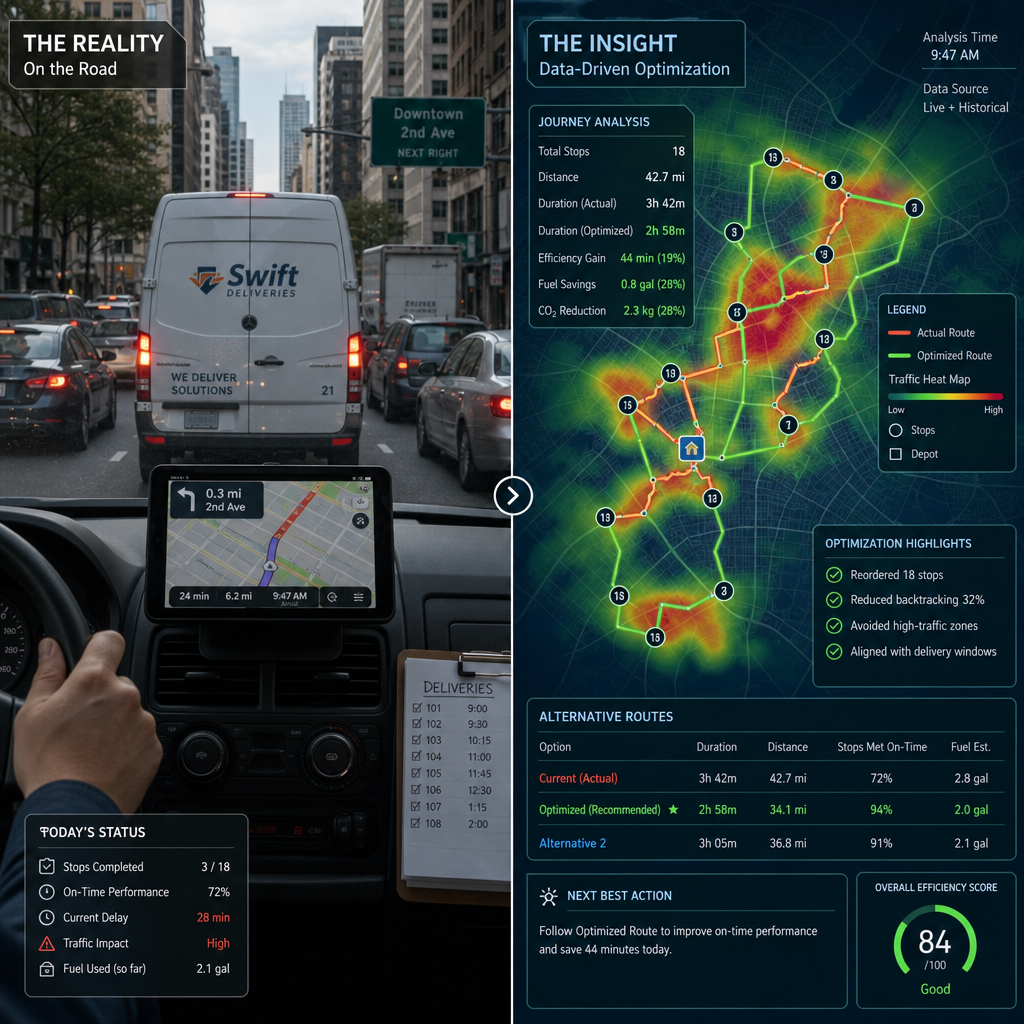
Comparison: Software vs. Consulting vs. Combined Approach
The table below compares three real approaches to transport cost optimisation. These are not hypothetical categories. They reflect how operations directors in the UK and Europe are actually addressing the problem.
| Approach | What It Solves Well | Where It Falls Short |
|---|---|---|
| Route Optimisation Software (e.g., routeoptimization.com, Scala Group platforms) | Reduces manual planning time, improves route sequencing within defined constraints, enables real-time exception handling, provides reporting dashboards | Cannot question its own configuration, relies on accurate input data, does not identify structural planning rule failures, gains plateau after initial deployment |
| Route Optimisation Consulting (e.g., Flow Dynamics) | Identifies decision-making cost leaks invisible to internal reporting, provides independent ground-truth data, delivers specific and quantified savings findings without requiring system replacement | Not a permanent operational tool, requires management engagement during diagnostic period, findings need internal implementation discipline to realise savings |
| Combined Approach (consulting diagnostic followed by targeted software configuration) | Software is configured against a verified operational reality rather than assumed conditions, planning rules are corrected before being encoded into a platform, delivers higher and more durable software ROI | Requires sequencing consulting before software selection or reconfiguration, higher upfront process investment, depends on quality of consulting diagnostic |
The combined approach consistently outperforms either option in isolation, but only when consulting precedes software decisions. Operations that buy software first and then bring in consultants to fix the configuration problems are paying twice for work that could have been done once.
Pro tip: If you are currently evaluating route optimisation software vendors, pause that process long enough to run a consulting diagnostic first. The findings will tell you exactly what requirements your software needs to satisfy, which is information you do not currently have.
When Transport Consulting UK Delivers Faster ROI
There are specific operational conditions under which route optimisation consulting delivers a faster return than any software investment. The first is when an operation already has software but has not seen costs improve in the last 12 to 18 months. Plateau performance after an initial software deployment is almost always a signal that the planning rules embedded in the system need independent review.
The second condition is when an operation has gone through significant network change: new customer contracts, depot closures or additions, fleet composition changes, or carrier mix changes. These events create drift between the network the software was configured for and the network it is now optimising. Software does not recalibrate itself. Consulting does the recalibration.
The third condition is when internal teams disagree about where costs are coming from. In practice, this disagreement is rarely resolved by pulling more reports from existing systems. The data in those systems reflects the same assumptions that produced the cost problem in the first place. An independent diagnostic with external hardware cuts through the internal debate with objective findings.
The No-Savings, No-Fee Model and What It Signals
Flow Dynamics operates on a specific commercial model: if the diagnostic does not identify at least £100,000 in realistic annual savings, the client pays nothing. This is not a marketing tactic. It is a structural signal about confidence in the diagnostic methodology. Consulting firms that charge regardless of findings have no financial skin in the quality of what they surface.
The guarantee also implies something important about where the savings floor is in most transport operations. A £100,000 minimum threshold suggests that operations below that level of hidden inefficiency are genuinely rare. The data consistently shows that operations with fleets of any meaningful size are carrying this level of correctable waste without knowing it.
How Flow Dynamics Approaches the Problem
Flow Dynamics is a transport optimisation consulting firm focused specifically on identifying hidden operational cost leaks in fleet management, routing logic, and load utilisation. The firm deploys proprietary hardware directly within live transport systems for a structured five-day period. This produces independent operational data that is not filtered through the client’s existing reporting infrastructure.
The diagnostic is not a software audit and does not require system replacement. The findings are specific, quantified, and tied to decision-making failures rather than reporting gaps. This distinction matters because reporting gaps are often visible to internal teams already. Decision-making failures, by definition, are not visible through the systems that are executing those decisions.
The firm targets operations directors and fleet executives who are already spending on route optimisation tools but have not seen the cost improvements those tools were purchased to deliver. The absence of system disruption during the diagnostic is deliberate. A five-day hardware deployment that does not interrupt live operations removes the primary objection that prevents most consulting engagements from getting started.
The competitive positioning relative to firms like SCCG and Scala Group is relevant here. Both of those organisations have strong backgrounds in transport technology, systems integration, and process consulting. Neither operates on a guaranteed savings model with independent hardware diagnostics. The Flow Dynamics model removes the principal risk in any consulting engagement: paying for analysis that does not produce actionable findings.
Frequently Asked Questions
Can route optimisation software replace consulting entirely?
No. Software can optimise within a defined set of rules and assumptions, but it cannot evaluate whether those rules and assumptions are correct. Consulting identifies the problems that software was configured to ignore. For operations that have already deployed software and are still experiencing cost overruns, consulting is the appropriate next step, not a software upgrade.
How long does a route optimisation consulting engagement typically take?
A credible diagnostic engagement should not require months of analysis to produce findings. Flow Dynamics completes its live hardware diagnostic within five days in the client’s live network. Findings are specific and quantified. Extended consulting timelines that stretch across quarters are generally a sign that the methodology relies on secondary data analysis rather than direct operational measurement.
What types of cost leaks does transport consulting actually find?
The most common findings involve fleet allocation logic that deploys vehicles at the wrong size tier for actual load patterns, routing assumptions that have not been updated to reflect network changes, load consolidation rules that are structurally suboptimal, and driver scheduling patterns that create unnecessary overtime or empty running. These are not visible in standard TMS reporting because the TMS is executing the same rules that produce these costs.
Is route optimisation consulting only relevant for large fleets?
The minimum savings threshold of £100,000 per year implies a fleet size where that figure is achievable, which in most UK operations means fleets of 30 vehicles or more. Below that scale, the absolute savings potential may not justify a full diagnostic engagement. Operations directors in mid-size to large fleets, or those managing complex multi-depot networks, are the clearest candidates for consulting-led diagnostics.
What is the difference between transport consulting UK firms and global logistics consultancies?
Global logistics consultancies typically focus on strategic network design, procurement, and broad supply chain restructuring. Transport consulting UK firms focused on operational cost optimisation work at the level of planning rules, routing logic, and fleet utilisation. The problems are different, and so are the methodologies. Flow Dynamics operates exclusively at the operational level: finding the specific decisions and rules inside a live network that are generating unnecessary cost.
How does independent hardware data differ from analysing existing TMS data?
Existing TMS data reflects what the system was told to expect and what it recorded against those expectations. It cannot capture deviations that the system did not know to look for. Independent hardware deployed in the live network captures actual vehicle behaviour, actual load patterns, actual route timing, and actual stop sequences regardless of what the planning system predicted. That gap between planned and actual behaviour is where the cost leaks live.
If you have deployed route optimisation software and are still looking for where the cost is going, or if you have had a consulting review that relied entirely on your own data, share your experience below. The specifics of where those diagnostics fell short tend to be more instructive than any general framework.
We would love your feedback and any insights you would share with others. What perspective would you add?
References
- McKinsey and Company research on supply chain digitisation and transport efficiency
- Statista data on UK logistics industry costs, fleet management, and route planning adoption rates
- Forbes analysis of consulting ROI models and performance-based fee structures in professional services
- UK Government transport and logistics industry statistics from the Department for Transport
- Ahrefs research on digital search behaviour and how logistics buyers evaluate consulting vs. software solutions